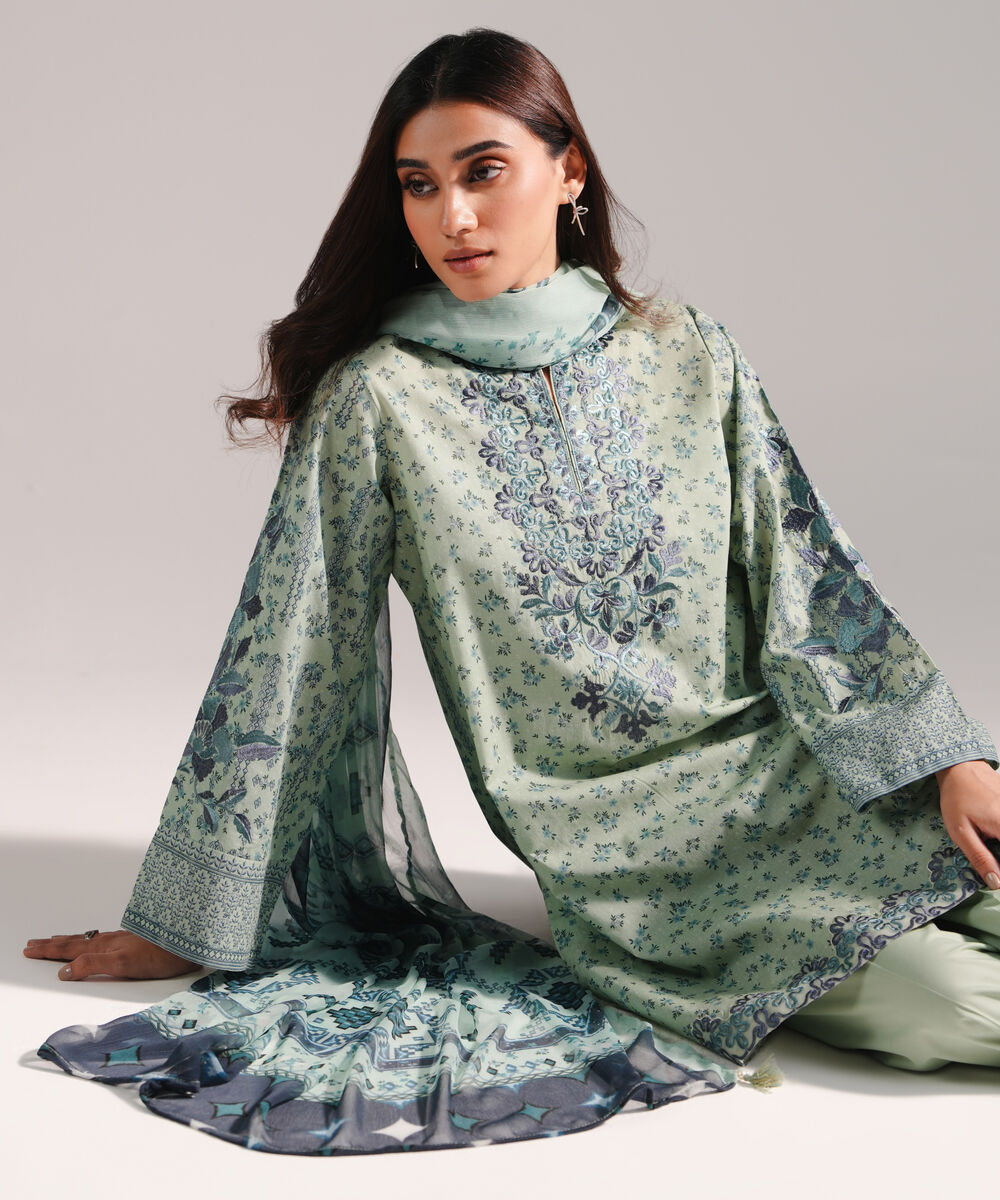
By Seerat Fatima · 6 August 2026 · Every price checked live the day this was published
Eastern ready-to-wear is the easiest thing in a Pakistani wardrobe to buy badly. A kurta is only ever half an outfit: the trouser under it, the dupatta over it, the shoe, and one earring decision turn it into something that either works for a whole day or fights you from 11am onward.
This is the full version — what to buy, what goes with what, and what four complete looks actually cost today.
1. What the eastern rail holds
| Shape | In stock |
|---|---|
| Kurtas | 16,027 |
| Kurtis | 1,079 |
| Shalwars | 938 |
| Frocks | 713 |
| 2-piece stitched | 358 |
| 3-piece stitched | 211 |
| Angrakhas | 69 |
The scale is worth seeing: 16,027 kurtas in stock against 211 stitched three-piece suits. Ready-to-wear here means kurtas and kurtis almost by definition, and a matched three-piece is the scarce, expensive end of the rail — which is exactly why it is worth owning one.
| Accessory | In stock |
|---|---|
| Dupattas | 6,018 |
| Khussas | 2,783 |
| Bangles | 2,086 |
| Heels | 943 |
| Flats | 608 |
| Kolhapuris | 67 |
| Jhumkas | 28 |
And the two numbers that decide most looks: 6,018 dupattas and 2,783 khussas. Jhumkas are the rarity at 28 pairs — a proper jhumka is a considered buy, not an impulse one.
2. The four decisions, in order
Every eastern look is the same four decisions taken in the same order. Get them in this order and the outfit assembles itself:
- Kurta length — short (above the hip) needs a fitted bottom; long (below the knee) needs a straight one. Getting this backwards is the most common mistake in the category.
- Bottom — cigarette pants for a short kurta, straight trousers for a long one, shalwar when the kurta is heavily embroidered and needs volume beneath it.
- Dupatta or none — a dupatta is a formality signal, not a requirement. Office and family events, yes. A weekday coffee, no.
- One accessory that stands out — earrings or shoes, not both. Everything else stays quiet.
3. Four complete looks
Every piece below is in stock and was price-checked the day this published.
Look 1 — The everyday kurti
For: A normal working day, university, a morning of errands

An embroidered yarn-dyed kurti with a plain trouser is the most-worn outfit in the country for a reason: it is one decision, it survives 38°C, and it looks the same at 9am and 6pm.


Shoes: Kolhapuris. Flat, open, and the one shoe that reads eastern without reading festive — and at under Rs. 2,000 the cheapest upgrade in this guide.
Earrings: Gold hoops. On a plain kurti the earring is the only jewellery doing any work, so it should be visible from the front, not just in profile.
| Piece | Item | Price today |
|---|---|---|
| Outfit | Limelight Yarn Dyed Kurti- Embroidered (Pret) | Rs. 3,499 → Rs. 2,599 |
| Shoes | Gul Ahmed Yellow Kolhapuri | Rs. 3,786 → Rs. 1,894 |
| Earrings | Gul Ahmed Golden C Hoop Earrings | Rs. 1,390 → Rs. 695 |
| Whole look | Rs. 5,188 (Rs. 8,675 at full price) |
Look 2 — The office three-piece
For: Office days, client visits, anywhere a dupatta is expected

A ready-to-wear shirt, trouser and dupatta arrives matched — no tailor, no guessing whether the dupatta goes. For an office it is the single safest eastern purchase.


Shoes: An off-white khussa. Closed, flat, and formal enough for a meeting; the neutral means it works with every colour in the rest of the wardrobe.
Earrings: Plain studs. A three-piece already has embroidery and a dupatta at the neckline. A jhumka on top of that is one thing too many before evening.
| Piece | Item | Price today |
|---|---|---|
| Outfit | Alkaram Studio RTW | SHIRT, TROUSER & DUPATTA | Rs. 8,190 → Rs. 4,914 |
| Shoes | Gul Ahmed Women Off White khussa | Rs. 5,990 → Rs. 2,995 |
| Earrings | Gul Ahmed Stud Earings | Rs. 1,990 → Rs. 995 |
| Whole look | Rs. 8,904 (Rs. 16,170 at full price) |
Look 3 — The dinner two-piece
For: Dinner, a family event, Eid-adjacent evenings

A stitched shirt-and-bottom set in a stronger colour is the shortcut to dressed-up: the tailoring is done, the fabric does the work, and it needs exactly two accessories.


Shoes: Golden kolhapuris. Metallics act as neutrals in eastern wear, so one gold pair covers every festive outfit you own.
Earrings: A jhumka. This is the one look on the list that carries a proper drop — and if you wear a jhumka, wear nothing at the neck.
| Piece | Item | Price today |
|---|---|---|
| Outfit | Sana Safinaz Stitched Yellow Shirt + Bottom | Rs. 12,304 → Rs. 4,922 |
| Shoes | Gul Ahmed Women Golden Kolhapuri | Rs. 4,990 → Rs. 2,495 |
| Earrings | Maria B Nourhan Jhumka | Rs. 3,990 |
| Whole look | Rs. 11,407 (Rs. 21,284 at full price) |
Look 4 — The kurti with jeans
For: Weekends, casual lunches, travel

The most under-rated combination in a Pakistani wardrobe: a short embroidered kurti over straight jeans. Eastern on top, western below, and no dupatta to manage.


Shoes: A tan khussa. Khussa with jeans is the detail that makes the combination look deliberate instead of accidental.
Earrings: Small coin drops. Enough movement to be interesting, small enough for a day with no plans.
| Piece | Item | Price today |
|---|---|---|
| Outfit | Limelight Yarn Dyed Kurti-Embroidered (Pret) | Rs. 3,499 → Rs. 2,624 |
| Shoes | Gul Ahmed Tan Khussa | Rs. 4,290 → Rs. 2,145 |
| Earrings | Gul Ahmed Coin Drop Earrings | Rs. 1,290 → Rs. 645 |
| Whole look | Rs. 5,414 (Rs. 9,079 at full price) |
4. The dupatta, three ways
- Straight over one shoulder — the office default. Pin it at the shoulder seam, not the sleeve, or it slides all day.
- Both ends front, hanging — the most formal drape and the least practical: it needs a hand free.
- Folded lengthwise across the chest — the version that survives a commute, because a folded dupatta does not catch on a bag strap.
Fabric decides which one works. Chiffon and net hold a drape but slip; cotton and khaddar stay put but bunch. If a dupatta will not stay, the answer is a pin, not a heavier fabric.
5. Jewellery for eastern wear
- Jhumkas own the outfit. Wear them with a plain shirt and nothing at the neck. On an embroidered neckline they compete and both lose.
- Studs for anything with a dupatta. The dupatta already frames your face; an earring that swings behind it is invisible anyway.
- Bangles are the volume knob. One thin bangle is daily. A stack of six is festive. There is no in-between, so choose deliberately.
- Match the metal to the embroidery. Gold thread with gold jewellery, silver with silver. This single rule does more for an eastern look than any amount of spending.
6. Shoes
Three families cover everything. Khussa is closed, flat and formal — the safest choice with a three-piece. Kolhapuri is open and casual, the everyday shoe, and the cheapest way to make a plain kurti look styled. Heels belong to evening and to floor-length shirts, where the extra height keeps the hem off the ground.
One practical note: metallic gold or silver behaves like a neutral in eastern wear the way beige does in western. If you own one dressy pair, make it metallic and it will go with everything.
7. Fabric, for the weather you actually have
- Lawn and cambric — the August default. Light, breathable, and the reason the entire industry runs on them.
- Khaddar and slub — heavier, better in the cooler months, and they hold embroidery without puckering.
- Viscose and yarn-dyed — the middle ground: they drape better than cotton and cost less than silk, which is why most ready-to-wear kurtis are made of them.
- Chiffon and organza — evening only. They need a lining, and a lining in daytime heat is a bad trade.
8. What to avoid
- A heavy dupatta on a working day. You will be carrying it by lunch, and a carried dupatta looks worse than no dupatta.
- Matching everything to one colour. Shoes, bag and dupatta in the same shade reads dated; one repeated colour is enough.
- Embroidered shoes with an embroidered shirt. Pick which one is the point.
- Buying a three-piece for the print alone. Check the trouser length before anything else — it is the piece most often wrong in ready-to-wear, and the hardest to fix.
9. What it costs
The four looks run from Rs. 5,188 to Rs. 11,407, and the accessories carry across all of them — one pair of kolhapuris and one pair of studs cover three of the four. That is the argument for spending on shoes and earrings once and rotating the clothes.
Before you buy, spend 30 seconds: compare live prices across all 22 brands, open any product's price history, and set a free price alert at TrendCompare.pk. Western wardrobe instead? The western ready-to-wear guide is here.
Method: TrendCompare 22-brand index, live pull on 6 August 2026. Stock counts are exact query results for in-stock women's products in each subcategory, so a piece filed under another label will not appear in these rows. All twelve products across the four looks were opened individually and price-verified the same day, and every image is the one the brand's own site serves. No photograph is repeated inside this article or shared with any other post on this blog. Prices change hourly and sizes sell out — check before you order. Styling guidance is editorial judgement, not measured data.