By Seerat Fatima · 1 August 2026 · Based on TrendCompare's live tracking of 262,000+ products across 22 Pakistani brands
(Yeh guide Roman Urdu mein bhi maujood hai: Azadi Sale Mein Fake Discount Kaise Pehchane)
Every year, as 14 August approaches, Pakistani shopping apps and websites turn green and white. Banners promise "Azadi Sale — Flat 70% Off!" and "Independence Day Mega Deals". Inboxes fill up. WhatsApp groups buzz with screenshots. And millions of Pakistanis open their wallets, believing they're getting the best deals of the year.
Many of them are. But some of them are paying almost exactly what the product cost three weeks earlier — while the price tag insists they just saved thousands of rupees.
This article explains how fake discounts work during Azadi Sale season in Pakistan, what our price-tracking data actually shows, and — most importantly — how you can tell a genuine Independence Day Sale from a manufactured one before you tap "Buy Now".
What's Really Happening Behind Some Azadi Sale Banners
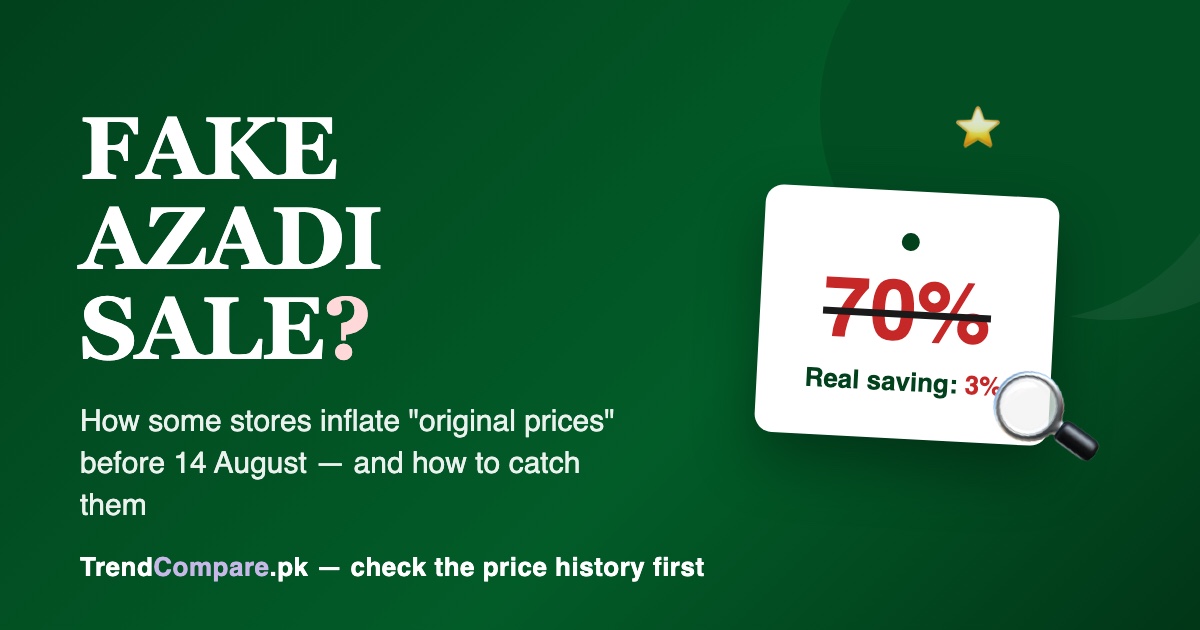
The trick has a name in retail: anchor inflation. It works because discounts are always relative. "Rs. 4,500" means little on its own — but "Rs. 15,000 Rs. 4,500" feels irresistible. The crossed-out number is the anchor, and it does all the psychological work.
Here's the playbook some online stores follow, step by step:
The Inflated-Anchor Playbook
- Two to three weeks before 14 August, the "original" price of a product quietly rises. A kurta that sold at Rs. 4,800 all summer is suddenly listed at Rs. 8,500. Nobody is expected to buy it at this price — it exists only to become the anchor.
- Sale day arrives. The product gets a bold red tag: "45% OFF — Azadi Sale!" The new price? Rs. 4,675. The shopper sees a huge discount. The seller sees a normal-price sale, plus the marketing glow of generosity.
- Urgency is added. Countdown timers, "Only 3 left!" labels, and "Sale ends midnight 14 August" messages push shoppers to decide fast — precisely so they don't pause to check what the product cost last month.
To be absolutely clear: this is a hypothetical illustration of a pattern, not an accusation against any specific company. Pakistani eCommerce includes hundreds of sellers, and pricing practices vary enormously — which is exactly why the honest ones deserve your business.
What Our Data Actually Shows
TrendCompare.pk tracks prices across 22 mainstream Pakistani fashion brands every hour — over 262,000 products. Because we record price history continuously, we can see the anchor game happen in the data. As of today, 1 August 2026:
- 63,496 items are marked "on sale" across the brands we track — and Azadi campaigns haven't even fully launched yet.
- 3,711 of those listings (about 5.8%) show a claimed "original price" that is more than three times the current sale price. A 70%+ markdown on fresh, in-season stock is almost never a real clearance — it's usually an inflated anchor. We exclude these from our honest-discount statistics entirely.
- Among listings with credible original prices, the average genuine discount is 41% — proof that real deals absolutely exist in Pakistan right now.
Our quarterly Sale Honesty Report goes deeper: it measures, brand by brand, whether the "was" price on a sale tag actually matches what the product sold for in the 30 days before the sale began. The leaders score above 95% — meaning when they say 50% off, you genuinely save 50%. Others score far lower. The gap between the best and worst is the difference of thousands of rupees on a single outfit.
Not Every Sale Is Fake — And That Matters
It would be lazy (and wrong) to conclude that Azadi Sale Pakistan campaigns are all theatre. They aren't. Our data shows most tracked brands run genuine promotions, especially:
- End-of-season clearance — summer lawn genuinely gets cheaper in August as brands clear inventory before autumn collections.
- Category-wide events — when a brand discounts its entire back catalogue, the markdowns are usually real; anchor inflation is harder to pull off at catalogue scale.
- Brands with consistent pricing histories — companies that hold stable prices for months and then discount visibly are showing you a real sale.
In fact, our Pakistan Fashion Price Index shows clothing prices fell about 7% between March and July 2026, driven largely by genuine summer sale season. Real discounts moved a national price index — that doesn't happen with fake tags.
How to Spot a Fake Azadi Sale
You don't need to be a data analyst. Five habits will protect you from almost every fake discount in Online Shopping Pakistan:
1. Check the price history, not the price tag
The single most powerful move. If you can see what a product cost over the past 30–60 days, the anchor game collapses instantly. On TrendCompare.pk, most product pages include a price-history view — if that Rs. 8,500 "original price" appeared only two weeks ago, you'll see the jump in the chart. A genuine discount shows a long, stable price followed by a real drop.
2. Compare the same product across stores
Price Comparison Pakistan is your friend. If a "70% off" item still costs more than a similar piece at a competing brand's regular price, the discount is doing marketing work, not saving you money. Cross-brand comparison takes two minutes and regularly saves Rs. 2,000–5,000 on a single outfit.
3. Be suspicious of discounts above 60% on fresh stock
Deep discounts on last season's leftovers? Believable. "75% off" on a just-launched, in-season collection? That anchor is almost certainly inflated. Our tracking flags listings whose claimed original price exceeds three times the sale price — and there are thousands of them live right now.
4. Screenshot prices before the sale
Old-school but effective. If you're eyeing something for 14 August, screenshot its price today. When the Azadi banner appears, compare. Thirty seconds of effort, complete immunity to the trick.
5. Read recent reviews and community threads
Pakistani shoppers talk. Facebook groups and Reddit threads regularly call out stores whose "sales" aren't. If multiple recent reviews mention price games, believe them over the banner.
Tips to Save Money During Independence Day Sales
- Make your list before the sale. Impulse purchases are where fake discounts feed. Decide what you actually need, then verify prices on those items only.
- Set price alerts early. On TrendCompare.pk you can set a free alert on any product — if the price genuinely drops for Azadi Sale, you'll know within the hour, with the full history to prove it's real.
- Shop the honest brands first. Our Sale Honesty rankings are public. Starting your search with high-honesty brands means the discounts you see are discounts you get.
- Compare before checkout, not after. Keep a comparison tab open. The Best Deals Pakistan shoppers find are almost always found across brands, not within one store's banner.
- Don't fear the timer. Countdown clocks reset. "Last chance" sales return. If a deal only survives if you decide in ninety seconds, it was engineered to stop you thinking.
- Check delivery charges and return policies. A Rs. 500 saving disappears fast under Rs. 300 delivery and a no-returns sale policy. Genuine sellers keep normal return terms during sales.
Frequently Asked Questions
What is a fake Azadi Sale?
A fake Azadi Sale (or fake Independence Day Sale) is when a seller raises a product's listed "original" price shortly before 14 August, then applies a discount that brings it back to — or barely below — the normal price. The shopper sees a large percentage off; in reality they save little or nothing.
How common are fake discounts in Pakistan?
Based on TrendCompare's tracking of 262,000+ products: about 5.8% of current sale listings show "original prices" more than triple the sale price — a strong inflated-anchor signal. Most sale listings, however, carry credible discounts averaging around 41%. Fake discounts are a real minority practice, not the norm.
How can I check a product's price history in Pakistan?
Use a price tracking tool. TrendCompare.pk records hourly prices for 22 Pakistani fashion brands and shows price history on product pages, so you can see exactly what an item cost before the sale banner appeared — free, no signup needed.
Are higher discount percentages always better?
No. A genuine 30% off a stable price saves you more than a fake 70% off an inflated one. Judge the final price against the product's history and against competing brands — never the percentage alone.
Which Pakistani brands give genuine discounts?
It varies by season, which is why we publish the quarterly Sale Honesty Report ranking all 22 tracked brands by how real their sale prices are. Top performers score above 95%; check the current rankings before you shop.
Is it illegal for stores to inflate prices before a sale?
Pakistan's Consumer Protection Acts (provincial) prohibit deceptive marketing, and misleading "was" prices can qualify. Enforcement in eCommerce, however, remains limited — which is why informed comparison shopping is currently a consumer's best protection.
When do real Azadi Sale discounts usually start?
Most brands launch campaigns in the first week of August, with the deepest genuine cuts typically appearing 11–14 August as brands compete. End-of-summer clearance overlaps with Azadi season, which is when real markdowns stack.
The Bottom Line
Azadi Sale season is genuinely one of the best times of the year to shop in Pakistan — if you can tell the real discounts from the manufactured ones. The sellers running fake sales are counting on one thing: that you'll trust the crossed-out number instead of checking it.
Don't give them that. Check the history. Compare across brands. Let the honest retailers — and there are many — win your business this 14 August.
Before you buy anything this Azadi Sale, take 30 seconds to verify the deal: compare live prices across all 22 major Pakistani brands, view any product's price history, and set free price alerts at TrendCompare.pk. Real deals have nothing to hide. 🇵🇰
Data in this article: TrendCompare 22-brand hourly index, snapshot 1 August 2026 (63,496 sale listings analysed). Methodology for sale-honesty measurement: trendcompare.pk/sale-honesty. No specific brand is accused of deceptive pricing in this article; aggregate patterns only.
(What to wear on 14 August, with tonight's prices — Azadi 2026: What to Wear, and What It Really Costs)
(Updated 1 August: brand-by-brand live sale data — Azadi Sale 2026: Which Brands to Buy Now)
(What the catalogue no longer has this Azadi Sale — The Trending Articles Selling Out)